For contractors performing renovation, repair, and painting work in pre-1978 housing and child-occupied facilities, EPA Lead Renovation, Repair and Painting (RRP) compliance does not end when the containment comes down.
Under 40 CFR § 745.86, renovation firms must retain and, when requested, make available to EPA the records necessary to demonstrate compliance with the RRP Rule for three years following completion of the renovation.
That means every covered renovation creates its own compliance record and its own retention timeline.
A project completed in March 2026 generally requires its applicable RRP documentation to remain available through March 2029. The retention period is tied to the completion of the renovation, not the contract date, tax year, or calendar year. EPA also makes clear that the three-year federal requirement does not replace longer record-retention obligations that may apply under other federal, state, tribal, contractual, or legal requirements.
For contractors, the practical issue is straightforward:
If you cannot produce the documentation, demonstrating that the work was performed in compliance becomes considerably more difficult.
Months or years after a renovation is completed, an EPA inspector cannot travel back in time to observe your containment, warning signs, worker training, cleaning procedures, or cleaning verification.
The inspector reviews the records.
EPA enforcement history includes alleged violations involving both failure to follow required lead-safe work practices and failure to establish or maintain documentation demonstrating that those requirements were followed.
This makes RRP recordkeeping much more than administrative paperwork.
The documentation becomes the historical evidence of what happened on the project.
A contractor may remember that containment was installed correctly. A certified renovator may remember performing cleaning verification. The crew may remember receiving training.
But years later, those memories are not nearly as useful as a documented project record showing:
who performed the work, what was done, when it was performed, and how compliance was verified.
That is exactly the type of problem iSpecX is designed to address.
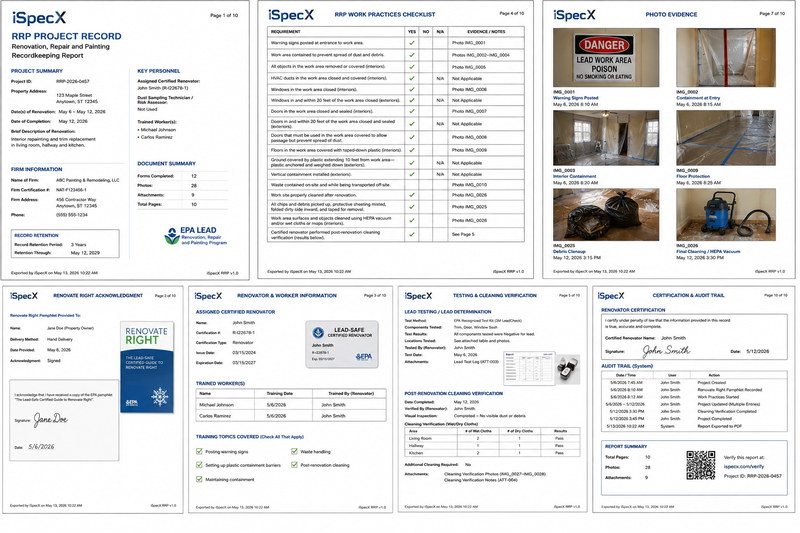
EPA states that renovation firms must retain applicable records for three years following completion of the renovation. These records can include documentation covering pre-renovation education, certified renovator qualifications and assignment, worker training, lead-based paint determinations, required work practices, and post-renovation cleaning verification.
A properly structured RRP project file may include:
Document delivery of the EPA Renovate Right pamphlet and retain the applicable acknowledgment or other documentation required by the pre-renovation education provisions.
Rather than relying on paperwork being returned to the office, contractors can capture acknowledgment documentation directly from the project and associate it with the correct job record.
The project record should identify the certified renovator assigned to the renovation.
EPA also requires certified renovators to have copies of their initial and most recent refresher course completion certificates available at the work site. Electronic copies may be used as long as the documents can actually be viewed and produced at the work site.
With iSpecX, firms can maintain information such as:
Certified renovator name
Certification documentation
Training dates
Certificate expiration information
Project assignment
Related project documentation
This helps connect the individual credential directly to the renovation where that individual was assigned.
Certified renovators are responsible for providing required on-the-job training to non-certified workers performing applicable tasks.
The renovation firm must retain documentation showing the training that was provided.
A digital project record can document:
Worker name
Training date
Certified renovator providing training
Work practices covered
Worker assignment
Supporting photographs or attachments
Instead of trying to reconstruct the crew months later, the information can be recorded while the project is active.
A good RRP record should follow the work itself.
EPA requires firms to document compliance with applicable work-practice requirements, including the involvement and responsibilities of the assigned certified renovator.
Depending on the project, field documentation can include items such as:
Warning signs installed
Interior or exterior work area established
Containment installed
Containment maintained during the renovation
Dust and debris controlled
Waste contained
Required cleaning performed
Certified renovator supervision documented
Prohibited practices avoided
Final visual inspection completed
Cleaning verification performed
This is where mobile field documentation becomes particularly valuable.
A contractor using iSpecX can build an RRP inspection or project workflow requiring specific fields to be completed before the project progresses.
Instead of writing:
“Containment installed.”
the record can contain:
Containment installed — 9/1/2026, 8:14 AM
along with the inspector or renovator responsible and project photographs showing the actual setup.
That creates a substantially more useful compliance record.
One of the simplest improvements an RRP firm can make is to systematically document work conditions with photographs.
Photographs can be associated with checklist items such as:
Renovate Right acknowledgment
Warning signs
Floor containment
Door and opening protection
Exterior ground containment
HEPA equipment
Waste containers
Work-area conditions
Final cleaning
Cleaning verification
Completed work
Photographs do not replace the regulatory records required by the RRP Rule, but they can provide valuable supporting documentation showing the condition of the job when the required activities occurred.
With iSpecX, those photographs can remain associated with the specific project instead of becoming unidentified images buried in an employee's phone.
Post-renovation cleaning verification is one of the most important points in an RRP project file.
EPA requires applicable records demonstrating that the assigned certified renovator performed the required post-renovation cleaning verification. EPA's inspection guidance specifically discusses documentation of the cleaning verification, including applicable results and cleaning-verification cloth information.
A digital workflow can prompt the certified renovator to document:
Date cleaning was completed
Visual inspection
Areas evaluated
Cleaning verification procedure
Cleaning verification results
Additional cleaning when required
Certified renovator completing verification
Supporting photographs
Completion date
That final completion date is particularly important because it establishes the starting point for the federal three-year retention period.
When a project is excluded from certain RRP requirements because affected components have been properly determined not to contain lead-based paint at regulated levels, the supporting testing documentation becomes critical.
EPA states that applicable records may include information such as:
Lead test kit manufacturer or brand
Components tested
Component locations
Test results
Paint-chip laboratory information where applicable
Inspection or risk-assessment documentation where applicable
EPA specifically recommends maintaining documentation supporting determinations that affected components are free of regulated lead-based paint.
iSpecX can create structured records for each tested component instead of relying on a loose collection of laboratory reports and handwritten notes.
For example:
Component: Living Room Window Trim
Location: North Wall
Test Method: EPA-Recognized Test Kit
Result: Negative
Certified Renovator: John Smith
Photograph: Attached
Date: September 1, 2026
The corresponding laboratory report or test documentation can then be stored with the same project.
One of the most important facts for contractors moving away from paper is that the EPA does not require RRP documentation to be stored exclusively on paper.
EPA has specifically stated that electronic recordkeeping is acceptable because the RRP Rule does not prescribe the format in which the records must be retained.
The critical requirement is that the renovation firm retain the necessary records and be capable of making them available to EPA.
EPA also permits required certified renovator documentation to be maintained electronically at the work site, provided the records can actually be displayed and viewed when needed.
This creates an ideal use case for a dedicated field documentation platform.
iSpecX gives renovation, environmental, restoration, and inspection firms a centralized way to collect RRP project information from the field and maintain the resulting project documentation.
Instead of splitting compliance information between paper forms, employee phones, email attachments, spreadsheets, cloud folders, and office filing cabinets, the project can be organized around a single digital record.
An RRP workflow in iSpecX can be configured to track:
Property information, project number, regulated work areas, renovation scope, start date and completion date.
Renovate Right distribution, acknowledgment documentation, delivery method and supporting records.
Assigned renovator, certification documentation, training information and credential expiration information.
Employees and subcontractor personnel receiving required on-the-job training and the certified renovator responsible for that training.
Project-specific checklists documenting warning signs, containment, dust control, waste handling, prohibited practices, cleaning and other applicable RRP activities.
Timestamped project photographs associated with the relevant inspection or compliance item.
EPA-recognized test-kit information, paint-chip samples, laboratory reports, component locations and results.
Final visual inspection, cleaning verification documentation, supporting images and the responsible certified renovator.
Maintain the complete project record after job completion so documentation can be retrieved if the project is reviewed later.
RRP documentation becomes much easier to manage when everything follows a simple principle:
One renovation. One project file. One complete compliance record.
The project's RRP information should not be distributed across:
A paper file in the office
Photos on the superintendent's phone
A certificate in HR
An acknowledgment attached to an email
A laboratory report in Dropbox
Cleaning verification in the certified renovator's truck
Worker training records in a spreadsheet
That system may technically contain the information somewhere, but finding and producing it later can become the real problem.
iSpecX allows firms to organize the information around the property and renovation project itself.
RRP retention should not be managed as a calendar-year purge.
For example:
Project A completed: March 12, 2026
Federal three-year retention point: March 12, 2029
Project B completed: September 18, 2026
Federal three-year retention point: September 18, 2029
Project C completed: January 6, 2027
Federal three-year retention point: January 6, 2030
Each project has its own timeline.
A software-based system can make the actual renovation completion date part of the permanent project metadata, giving firms a far better foundation for administering retention requirements.
Many organizations may also elect to retain these records longer than the federal three-year minimum because other regulatory, contractual, litigation, insurance, or state requirements can extend beyond that period.
RRP documentation becomes especially important when multiple contractors participate in the same regulated renovation.
EPA states that when a general contractor and subcontractors are involved, all renovation firms involved share responsibility for retaining and making the necessary RRP records available. The records do not necessarily have to be duplicated by every firm, but a firm relying on another contractor to maintain them must still be capable of accessing and producing those records to EPA in a timely manner.
That makes the question:
“Who has the RRP file?”
a poor question to answer after an EPA records request arrives.
Establish responsibility before work begins.
A shared digital project documentation process can provide much greater visibility into who generated each record and where the documentation resides.
A compliance system should work when the crew is busy.
Not just when the compliance manager is sitting at a desk.
Ask a simple question:
Can your certified renovator complete the required project documentation from the field on a Friday afternoon without going back to the office?
If the answer is no, the recordkeeping system will eventually develop gaps.
That is why iSpecX approaches documentation as a field workflow, not simply a document-storage system.
The goal is to capture the information when the work happens.
Perform it. Document it. Photograph it. Verify it. Store it.
Before closing an RRP-regulated project, firms should confirm that the applicable project record contains:
Renovate Right distribution documentation
Owner or occupant acknowledgment documentation
Assigned certified renovator
Certified renovator training documentation
Non-certified worker training records
Lead-testing or lead-free determination documentation, when applicable
Required work-practice documentation
Containment and warning-sign documentation
Waste-handling documentation
Project photographs
Final visual inspection documentation
Cleaning verification records
Supporting reports and laboratory documentation
Actual renovation completion date
Then make sure that information remains retrievable for at least the applicable regulatory retention period.
Under 40 CFR § 745.86, applicable records must generally be retained for three years following completion of the renovation. Other laws or obligations may require longer retention.
Yes. EPA states that the RRP Rule does not specify the format in which required records must be maintained. Electronic records are acceptable as long as the firm retains the necessary documentation and can make it available when requested.
Yes. EPA permits electronic copies at the work site provided they can actually be viewed when needed.
The renovation firm is responsible for retaining and making required records available to EPA. The certified renovator has specific responsibility for preparing records demonstrating compliance with applicable work-practice requirements.
Multiple renovation firms involved in the project may share recordkeeping responsibility. EPA allows records to be held by one firm, but the other responsible firms must still be able to access and produce them in a timely manner when requested.
No. The requirement runs for three years following completion of the individual renovation. Therefore, each renovation effectively has its own retention timeline.
RRP compliance documentation does not need to live in filing cabinets, employee trucks, spreadsheets, phones, and disconnected cloud folders.
With iSpecX, firms can build standardized RRP workflows that capture required project information in the field, associate photographs and supporting documents with the project, identify responsible personnel, document completion, and maintain an organized digital project history.
Make your RRP documentation part of the work—not paperwork you try to reconstruct after the work is finished.
Create customized inspection forms, compliance checklists, certified-renovator records, worker-training logs, photographic documentation, cleaning-verification workflows, testing records, and long-term project files—all connected to the property and project where the work occurred.
iSpecX — Inspect. Document. Manage.